Planning a celebration of life while you’re grieving is one of the hardest things a family can be asked to do. You’re holding so much — the weight of loss, the needs of everyone around you, and the quiet pressure of wanting to get it right for the person you’ve lost.
This guide is here to make it a little easier. We’ll walk through every step, from the first decisions to the final details, so you can focus on what matters most: gathering the people who loved them and honouring a life that deserves to be celebrated.
The content on this site may include affiliate links. As a Zazzle Ambassador I earn from qualifying purchases. This means that, at zero cost to you, we will earn an affiliate commission if you click on one of the links and buy something.
There’s no single right way to do this. A celebration of life can be as simple or as personal as you choose. It might be a quiet gathering at home, an outdoor memorial in a favourite place, or a warm reception with music, food, and stories. What makes it meaningful isn’t the scale — it’s the care behind it.
What Is a Celebration of Life?
A celebration of life is a memorial gathering focused on honouring who someone was — their personality, their passions, the way they made people feel. Unlike a traditional funeral service, which often follows a set religious or formal structure, a celebration of life is more flexible. There are no rules about what it has to look like.
Some families hold a celebration of life instead of a funeral. Others hold one alongside a funeral, or in the weeks and months after, when people have had time to travel and the initial shock has settled. Whenever you hold it, and however you shape it, a celebration of life gives the people who loved your person a chance to come together, share memories, and say a proper goodbye.
Step 1: Decide on the Basics
Before you can plan anything else, a few key decisions will shape everything that follows.
When to Hold It
There’s no rule that says a celebration of life must happen within days of a death. Many families choose to hold one a few weeks later — sometimes even months — particularly when guests need time to travel, or when the family needs a little breathing room before they’re ready to gather.
If you’re holding a traditional funeral first, you might plan the celebration of life as a separate event a few weeks afterwards, when the atmosphere can be warmer and less rushed.
Where to Hold It
The venue sets the tone for the whole gathering. Think about what would have felt most like the person you’re celebrating.
- Family home or garden — intimate and personal; works well for smaller gatherings
- Funeral home — practical and often well-equipped for services of all sizes
- Church or place of worship — appropriate if faith was important to them
- A favourite place — a local park, a beach, a restaurant they loved, a golf club, a community hall
- Hired venue — a hotel function room or events space for larger gatherings
How Many Guests
An intimate gathering of close family and friends feels very different from an open-invitation memorial. Think about whether you’d like to keep it small and private, or whether a wider circle of colleagues, neighbours, and community would feel right.
The Tone
This is the most personal decision of all. Was this someone who would have wanted solemnity and quiet reflection, or someone who would have insisted on music, laughter, and a good meal? Most celebrations of life land somewhere in the middle — warm, personal, and gently joyful rather than heavy with grief.
Step 2: Set a Budget
Celebrations of life can cost very little or quite a lot, depending on the choices you make. Being clear about your budget early helps avoid stress later.
Costs to consider:
- Venue hire
- Catering (food and drinks)
- Flowers and decorations
- Printed stationery (invitations, programmes, prayer cards)
- Audio-visual equipment (for slideshows or music)
- Transport
Ways to keep costs down:
- Hold the gathering at home or in a family member’s garden
- Ask friends and family to contribute dishes (a shared meal can feel more comforting than catered food)
- Keep decorations simple — flowers from a local market, framed photos, and candles go a long way
- DIY your decorations and signage rather than hiring a stylist
Step 3: Send Invitations
Once you have a date, time, and venue, let people know. For close family and immediate friends, a phone call or message is often enough. For a wider gathering, a formal invitation — printed or digital — makes things clear and gives guests everything they need in one place.
What to Include on a Celebration of Life Invitation
- Full name of the person being celebrated
- Date, time, and location of the service
- Any parking or travel information
- Dress code (if you have a preference — many families now ask for colour rather than black)
- RSVP details
- Any special requests (e.g. “please bring a favourite photo to share”)
Digital vs Printed Invitations
Digital invitations are quick to send, easy to forward, and kinder on the budget. They work well when guest lists include people spread across different locations. Printed invitations feel more formal and personal — something guests can keep.
For guidance on wording, see What Information to Include on a Funeral Invitation.
If you’d like a beautiful printed or digital invitation, I have a range of designs in my store — from simple and modern to soft and floral — that can be personalised with your loved one’s name, photo, and service details.
Step 4: Plan the Order of Service
Even an informal celebration of life benefits from a gentle structure. A simple order of service helps guests know what to expect and gives the gathering a sense of flow — a beginning, a middle, and a close.
A Simple Structure to Work From
- Welcome — a family member or officiant opens the gathering
- Music — an opening song or piece of music
- Tributes — one or two people share memories or a short speech
- Reading or poem — a favourite piece of writing, a prayer, or a meaningful quote
- Open invitation — guests invited to share a memory (optional)
- Slideshow or video tribute (optional)
- Closing words — a thank you to guests; any information about what follows (reception, etc.)
- Closing music
You don’t need to stick rigidly to this structure. Let it breathe. Leave space for the moments that happen naturally.
Programmes and Order of Service Booklets
Printed programmes give guests something to hold and follow along with. They also become a keepsake — something many people tuck away and keep for years.
A programme typically includes the order of service, the words to any hymns or readings guests might join in with, and a short tribute to the person being celebrated. Some families include a favourite photo on the cover.
- For guidance on what to include, see What to Include in a Funeral Program.
Step 5: Choose Music and Readings
Music and words are often the most remembered parts of a memorial gathering. They’re also the most personal.
Music
Don’t feel limited to hymns or classical music. Think about what the person you’re celebrating actually loved. Their favourite songs, the music that played at meaningful moments in their life, or a piece that simply captures something true about who they were.
If you’d like a live element, a musician or choir adds warmth. But a well-curated playlist played through good speakers is just as meaningful.
Readings
A reading might be a poem, a scripture passage, a favourite quote, a letter written to them, or even a few lines from a book they loved. It doesn’t need to be long — a single paragraph read with care can carry more weight than pages.
If you’re struggling to find the right words, a simple internet search for “celebration of life poems” or “memorial readings” will offer dozens of options. Or ask the people who knew them best — often someone will know exactly the right passage.
Speakers and Tributes
Think carefully about who you ask to speak. Two or three speakers is usually enough — more than that and the service can feel long and overwhelming for grieving guests.
Give speakers a suggested length (3–5 minutes is a good guide) and let them know they can always write something to be read on their behalf if they’re worried about holding it together.
Step 6: Create a Meaningful Space
The physical space you create tells guests, before a word is spoken, that this person was loved and carefully remembered.
A Welcome Sign
A welcome sign at the entrance — bearing their name and perhaps a favourite photo or quote — greets guests and sets the tone from the moment they arrive. It’s a simple detail that makes a big difference.
A Memory Table
A memory table gives guests somewhere to pause, look, and remember. A few elements that work beautifully together:
- Framed photographs — a mix of eras and occasions
- A candle or two
- Flowers (their favourites if you know them)
- A keepsake or two that meant something to them — a book, a hat, a trophy, a hobby item
- Prayer cards for guests to take away
For more ideas, see our guide to creating a memorial table (coming soon).
Memorial and Prayer Cards
Funeral prayer cards are small printed keepsakes that guests can take home — a photo, a name, a date, and a short quote or prayer. They can be placed on the memory table, handed out as guests arrive, or tucked inside programmes.
- See our guide: What is a Funeral Prayer Card
- Browse our collection of Memorial and Prayer Cards here
Photo Display
Photos are the heart of any celebration of life. A collection of images spanning their whole life — childhood, young adulthood, family moments, friendships — gives guests something to gather around and remember together.
Options range from a simple arrangement of framed photos on a table to a string-light display, a photo board, or a digital frame cycling through images throughout the service.
Step 7: Plan Food and Drinks
Food brings people together. Even the simplest spread — tea, sandwiches, a few homemade cakes — creates warmth and gives guests a reason to stay, talk, and share memories after the formal service ends.
Think about:
- A light reception — drinks and finger food after the service; works for any size gathering
- A shared meal — more informal; works beautifully for home gatherings or smaller groups
- Catered vs home-cooked — professional catering takes the pressure off the family; home-cooked or potluck food feels personal and is gentler on the budget
If the person you’re celebrating had a favourite food or drink, including it is a lovely personal touch. Their favourite biscuits on the table, their preferred tea, a bottle of their favourite wine.
Step 8: Add Personal Touches
The details that make a celebration of life feel truly like them are often the simplest ones.
A memory jar or share-a-memory cards — place cards and pens on a table and invite guests to write down a favourite memory. These can be collected and kept by the family afterwards.
A photo slideshow — a 5–10 minute slideshow set to music is one of the most moving parts of any memorial gathering. It doesn’t need to be professionally produced — a simple sequence of photos in PowerPoint or a free online tool is more than enough.
A theme rooted in their passions — a keen gardener might be honoured with wildflower seed packets as a favour for guests to take home. A music lover might have their favourite album playing as people arrive. A lifelong football supporter might have their team’s colours woven through the flowers.
A guest book or memory book — a book where guests can write messages, sign their names, and leave a note for the family. Something to keep and return to in the months that follow.
- See our guide: What is the Purpose of a Funeral Guestbook
- Browse our collection Funeral Guestbooks here
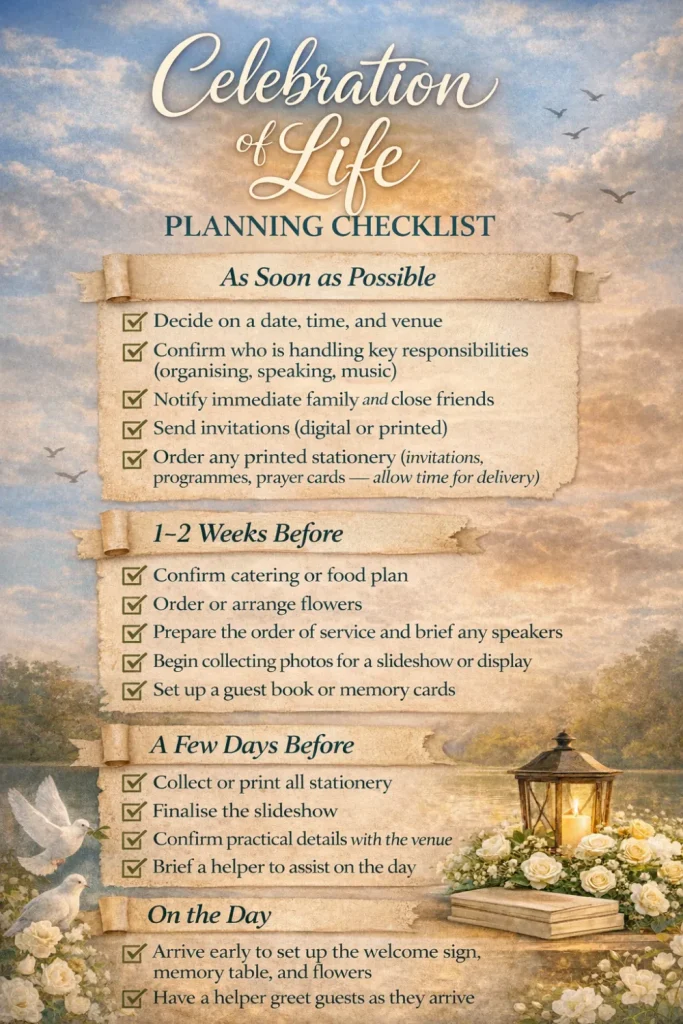
Your Celebration of Life Planning Checklist
Use this as a simple reference as you work through your planning.
As Soon as Possible
- Decide on a date, time, and venue
- Confirm who is handling key responsibilities (organising, speaking, music)
- Notify immediate family and close friends
- Send invitations (digital or printed)
- Order any printed stationery (invitations, programmes, prayer cards — allow time for delivery)
1–2 Weeks Before
- Confirm catering or food plan
- Order or arrange flowers
- Prepare the order of service and brief any speakers
- Begin collecting photos for a slideshow or display
- Set up a guest book or memory cards
A Few Days Before
- Collect or print all stationery
- Finalise the slideshow
- Confirm practical details with the venue
- Brief a helper to assist on the day (setting up, greeting guests, taking photos)
On the Day
- Arrive early to set up the welcome sign, memory table, and flowers
- Have a helper greet guests as they arrive
- Allow the gathering to breathe — some of the most meaningful moments happen in the spaces between the planned ones
A Gentle Final Thought
No celebration of life will be perfect. Something will run a little long, the flowers won’t quite look as you imagined, someone will cry before they finish their tribute. That’s alright. It’s more than alright.
What your guests will remember is that they were gathered together. That there was space to share memories and feel the loss together. That the person they loved was honoured with care.
That’s all a celebration of life needs to be.
Frequently Asked Questions
How long does a celebration of life last?
Most celebrations of life last between one and two hours for the formal part of the gathering, followed by a reception that can run for as long as feels right. Shorter is often better — a focused, heartfelt hour leaves guests feeling moved rather than exhausted.
Is there a difference between a funeral and a celebration of life?
A traditional funeral is often a more formal religious or structured service, focused on farewell and mourning. A celebration of life tends to be warmer and more personal — focused on who the person was, what they loved, and the impact they had. The two aren’t mutually exclusive; many families hold both.
Can you have a celebration of life months after the death?
Absolutely. There’s no rule about timing. Many families hold a small private funeral immediately after the death and then plan a celebration of life weeks or months later, when travelling family can attend and the family has had a little more time to prepare something meaningful.
Does a celebration of life have to be religious?
Not at all. A celebration of life can be entirely secular, spiritual in a personal rather than religious sense, or as faith-centred as you choose. It’s entirely up to your family and what felt true to the person you’re celebrating.
What do you wear to a celebration of life?
There’s no strict dress code. Many families now ask guests to wear a favourite colour rather than black, or to dress in a way that reflects the person’s personality. If you have a preference, include it in the invitation. If not, guests will generally dress smartly and respectfully.